
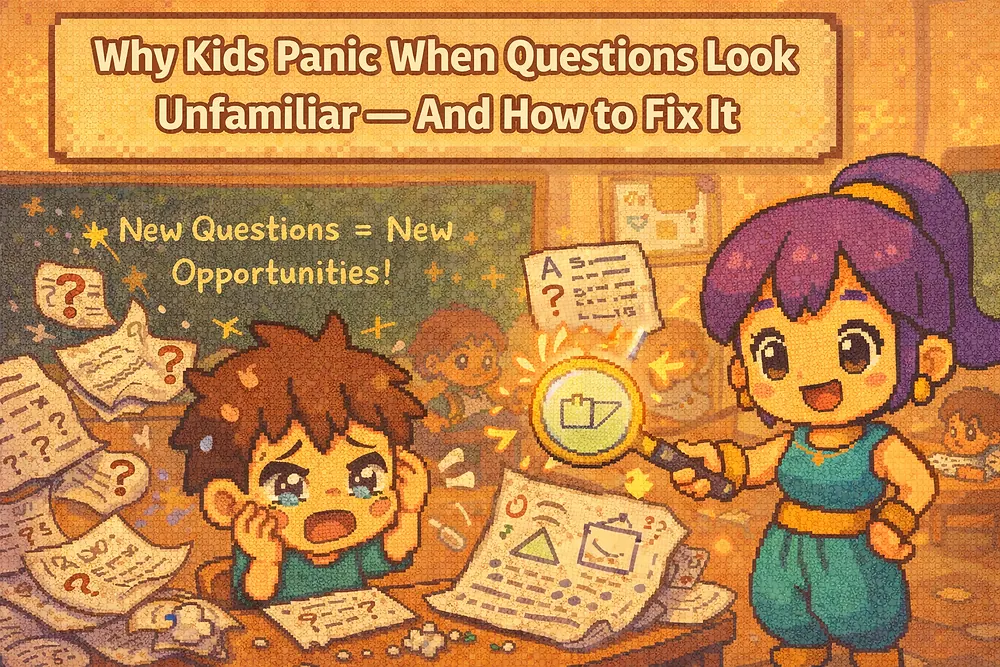
"I've never seen this before." That single thought is often enough to send a child into panic during tests and exams.
Many students don't struggle because the question is too difficult. They struggle because the question looks different from what they practiced. The wording changes. The diagram looks unfamiliar. The context feels new. Suddenly, confidence drops — even when the concept is something they actually know.
At Genie Education Hub, this is one of the most common challenges we see. The good news is that this kind of panic is not a personality flaw or a lack of ability. It's a training issue — and it can be fixed.
Here's what's really happening, and what truly helps.
Why Unfamiliar Questions Trigger Panic
When students practice, they often see questions in similar formats. Over time, their brain learns to associate a specific "look" with a specific method.
So when an exam question doesn't match that familiar pattern, the brain reacts with uncertainty. Instead of thinking, it asks: "What method is this?" "Have I done this before?" "What if I get it wrong?"
That uncertainty creates stress. Stress then blocks logical thinking, making even simple reasoning feel impossible.
This is especially common in students who rely heavily on memorization — something we discuss more in Why Science Isn't About Memorizing Facts — It's About Asking Questions.
Memorization works only when questions look the same. Understanding works even when they don't.
Why Panic Makes Everything Worse
Once panic sets in, students often:
- rush through questions
- skip steps
- misread key words
- abandon questions they could actually solve
The fear of unfamiliarity quickly turns into fear of failure. And when children are afraid of making mistakes, their brain stops exploring solutions.
This fear response is closely linked to what we explain in Why We Shouldn't Teach Kids to Fear Failure. When mistakes feel dangerous, unfamiliar questions feel threatening.
The Real Problem Isn't New Questions — It's Rigid Thinking
Exams are designed to test understanding, not repetition. That's why examiners intentionally vary:
- phrasing
- context
- diagrams
- data presentation
Students who understand concepts can adapt. Students who memorize steps cannot. This is why some children say, "I know this topic, but I couldn't do the question." What they really mean is, "I know the steps, but I don't know how to adjust them."
We see this clearly in Math word problems and Science open-ended questions, as discussed in The Real Reason Kids Struggle with Word Problems (and How to Fix It) and How Model Drawing Helps Kids Understand Word Problems Better.
How to Fix It: What Actually Helps
Build Conceptual Understanding, Not Pattern Recognition
The first and most important fix is shifting from "Which method is this?" to "What is this question really about?"
At Genie, we constantly guide students to identify:
- what the question is asking
- what information is given
- what concept connects them
When students understand the idea behind a topic, unfamiliar presentation stops being scary.
Teach a Pause-and-Plan Habit
Panic thrives in rushed thinking. We teach students to slow down intentionally by:
- taking one deep breath
- reading the question twice
- underlining key words
- rephrasing the question in their own words
This small pause gives the brain time to switch from fear to reasoning.
Normalise "I Don't Recognise This"
One powerful mindset shift we teach is this: "If the question looks unfamiliar, it doesn't mean it's harder. It just means it's testing understanding." When students expect unfamiliarity, they stop panicking when it appears.
This idea links closely to Why Kids Freeze During Exams — And What Actually Helps.
Train Flexible Thinking Through Variety
Instead of practicing the same type of question repeatedly, we expose students to:
- different wordings
- different diagrams
- mixed-topic questions
This trains adaptability. Over time, students stop relying on recognition and start relying on reasoning.
Encourage Attempting Before Perfection
Many students freeze because they think they need the full solution immediately. We teach them to start with what they know:
- write down given information
- draw a simple diagram
- state a basic concept
Once the first step is written, clarity often follows. This approach also builds confidence, especially when students stop comparing themselves to others, as explored in What Happens When Kids Stop Comparing Themselves to Others.
Final Thoughts
Unfamiliar questions are not traps. They are invitations to think.
When children learn to stay calm, focus on understanding, and trust their reasoning, unfamiliar questions lose their power to intimidate.
At Genie Education Hub, we don't train students to recognize patterns. We train them to think flexibly, reason clearly, and adapt confidently — even when the question looks new. And once that skill is built, exams stop feeling like a threat and start feeling like a challenge.