
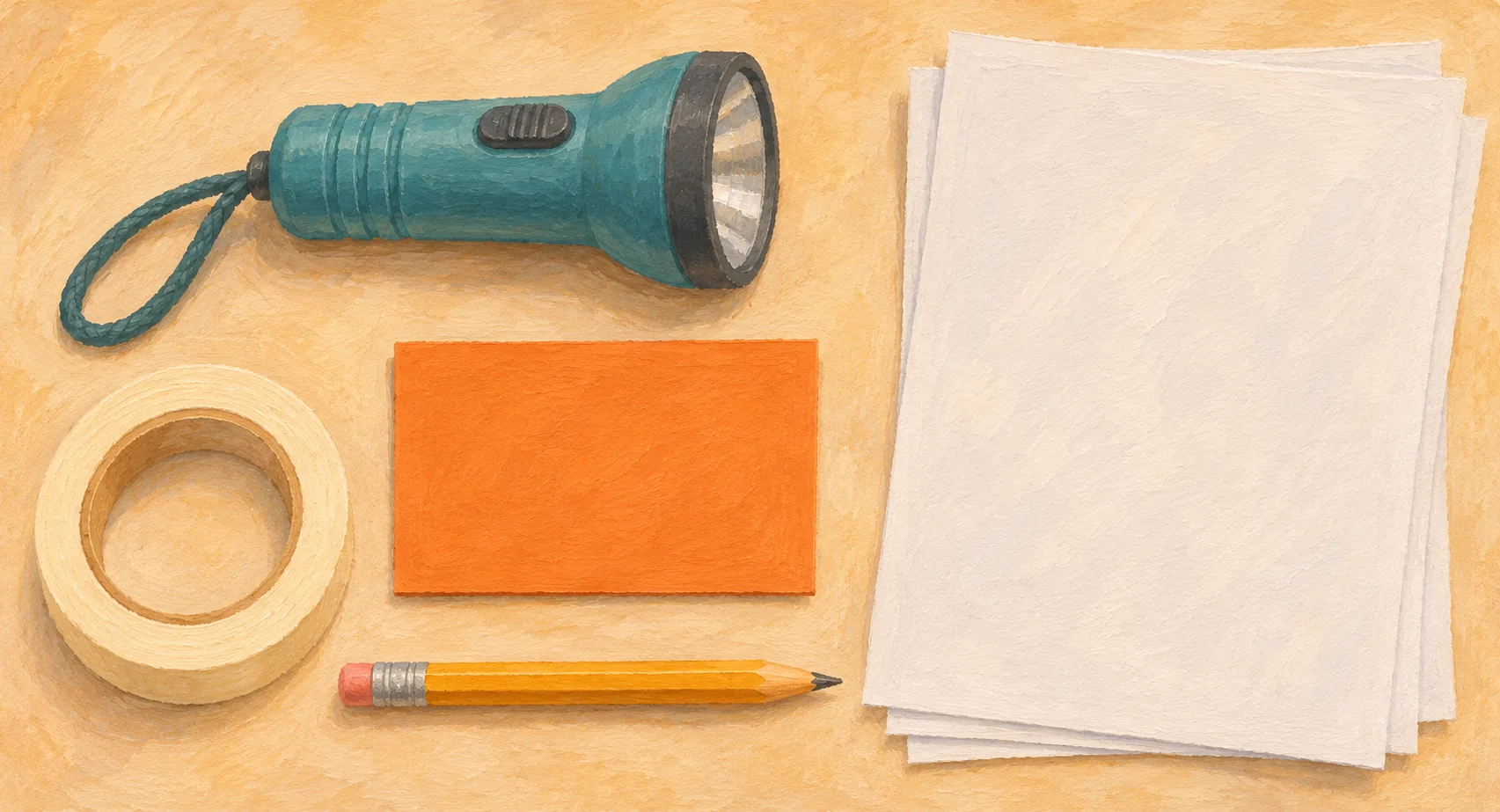
Hold a small piece of card in front of a torch and its shadow can cover most of a sheet of paper. Slide the same card towards the paper and the shadow shrinks. If your child explains that the card “got closer”, ask one more question. Closer to what? Moving closer to the torch and moving closer to the paper give different results.
Give the shadow somewhere to land
Tape a sheet of white paper to a wall. Rest a torch on a book about 60 cm away, pointing straight at the paper. Choose a light that makes a spreading patch on the wall. A small piece of opaque card, about the width of your thumb, will be the object. Opaque means light cannot pass through it.
Hold the card upright, with its flat face towards the paper. Keep it in the middle of the beam so you can see light around both sides of its shadow. Hold it by the bottom edge so your fingers stay clear of the part you want to compare.
Move the card twice
Leave the torch and paper where they are. Ask your child to predict which position will give a wider shadow. For both tries, keep the card facing the same way.
- Position A. Hold the card about 15 cm from the torch. Have your child mark the left and right edges of the shadow lightly on the paper and label the pair A.
- Position B. Slide the card straight towards the wall until it is about 30 cm from the torch. Mark the two edges again and label them B.
Compare the gap between each pair of marks. With a spreading beam, the A marks should be farther apart. If the edges look fuzzy, use the same part of the dark outline for both marks. If the card covers the whole patch of light, try a narrower piece and repeat both positions.
Draw the two paths that set the width
Sketch the setup from above. On scrap paper, draw a dot for the light on the left and a vertical line for the wall on the right. Draw a short upright line for the card between them. Using a ruler, draw a straight line from the dot through the top tip of the card and carry it on to the wall. Do the same through the bottom tip. The space between the two lines at the wall shows the shadow in this sketch from above.
Now draw the same card closer to the dot on a fresh sketch. The two lines through its tips spread farther apart by the time they reach the wall. A child might explain it this way. “The card stayed the same size. Close to the torch, it blocked the light going to a wider part of the wall.” The dot stands for a small light source. A real torch can give softer edges than the pencil lines.
Try it the other way round
A paper puppet casts a shadow too wide to fit on a screen. The lamp and screen must stay in place. Which way would you move the puppet? Ask your child to point first, then explain the move to someone who cannot see the setup.
See one possible explanation
Move the puppet towards the screen, keeping it facing the same way. It is now farther from the lamp. The light it blocks would have reached a narrower part of the screen, so the shadow gets smaller.
For a final check, hand the card to your child and let them direct you. Can you make the shadow wider using only their spoken instructions? That gives them a reason to name the object that moves, the point it moves towards and what happens on the wall.
For another home activity, try our guide to changing one thing at a time. If your child can describe the shadow but gets stuck explaining why, our observation and explanation guide has a second example to practise with.
Questacon demonstrates the change in shadow size in Shadow Puppets. Science Buddies illustrates how the rays spread in Explore Shadows with a Shadow Play. The two marked positions and the questions above are Genie's suggestions for practising at home.