
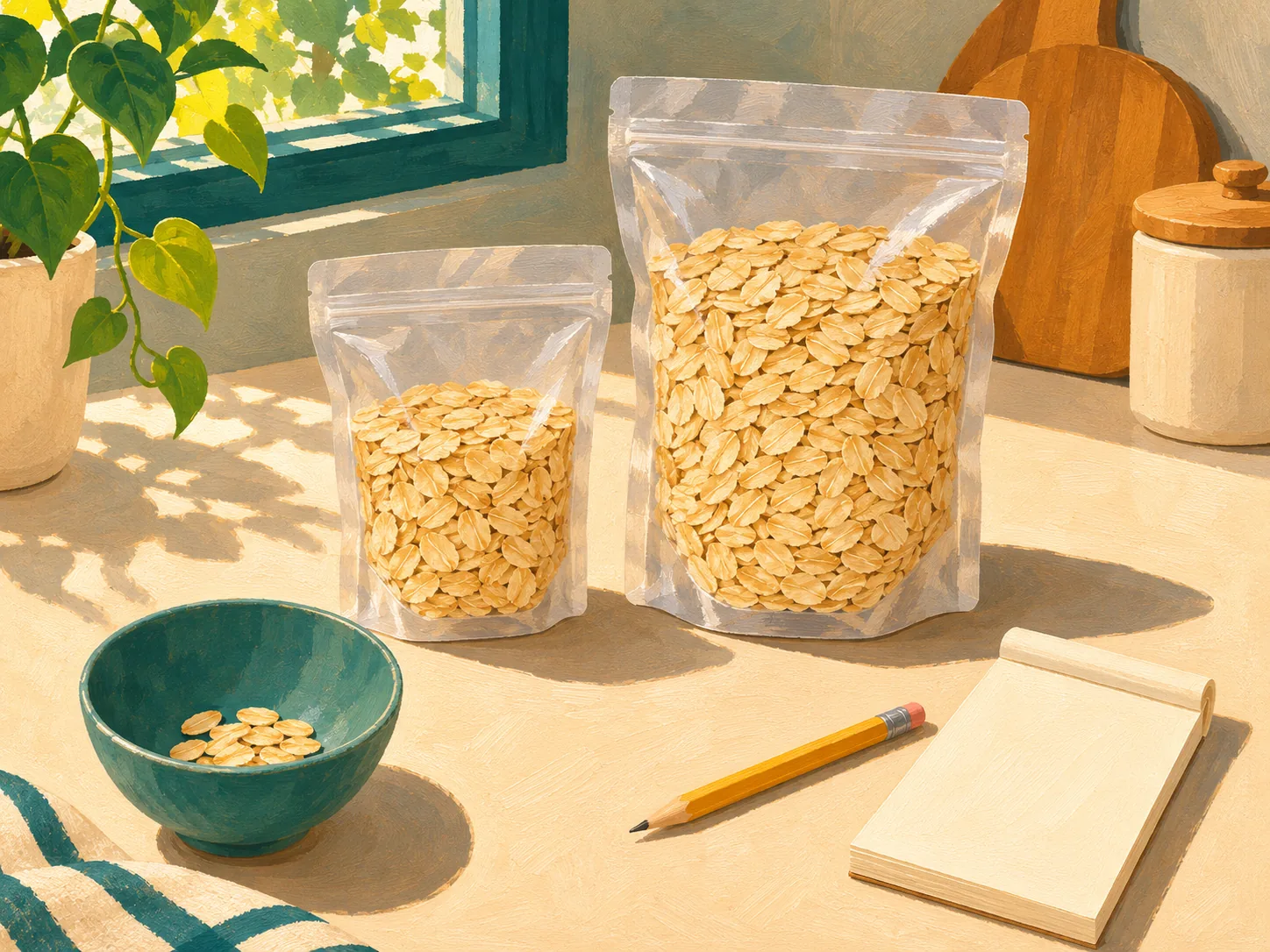
Put two imaginary bags of the same rolled oats on the kitchen table. One holds 300 g and costs S$2.10. The other holds 500 g and costs S$3.00. Ask your child, “Which one costs less?” If they say “the small bag”, ask what they are comparing. They may already have answered your question perfectly. You would hand over less money for the small bag.
Now change just a few words. “Which one costs less for the same amount of oats?” Give your child a moment with that version. You can do the whole activity with a pencil and two handwritten labels. All the prices here are made up for practice.
Give both bags the same measuring scoop
Imagine a scoop that holds exactly 100 g of oats. Ask how many full scoops would empty each bag. A child who finds the division hard to picture can draw three boxes under the first label and five under the second. Each box stands for the same weight.
Write 210 cents across the top of the three boxes. Share that cost equally between them. Each box gets 70 cents. Do the same with the five boxes, sharing 300 cents this time. Each gets 60 cents. Working in cents lets your child think about equal groups before dealing with a decimal point.
| Bag | Pack price | Price per 100 g |
|---|---|---|
| 300 g | S$2.10 | 210¢ ÷ 3 = 70¢ |
| 500 g | S$3.00 | 300¢ ÷ 5 = 60¢ |
Ask your child to read the last column aloud, including the words “per 100 g”. The 500 g bag costs 10 cents less for each 100 g of oats. To check, put its five scoops back together. Five lots of 60 cents make 300 cents, the S$3.00 on the label.
Give your child S$2.50 to spend
Keep the two labels exactly as they are. This time say, “You have S$2.50 and the shop sells only whole bags. Which bag can you take to the till?” The 300 g bag fits the budget and leaves 40 cents. The 500 g bag has the lower price per scoop, but buying it would take another 50 cents beyond the budget.
If your child chooses the larger bag again, put its S$3.00 label next to the S$2.50 budget. Ask, “How much would the cashier ask for?” Then try a different question. If you have enough money for either bag and will use all 500 g, which gives you more oats for each dollar? The choice changes when the question changes.
Switch the labels and let your child decide
For a fresh pair, write 400 g for S$2.60 and 600 g for S$4.20. Ask your child to choose the lower price per 100 g and show how they know. If they point straight to the bigger bag, invite them to put a price in just one of its six boxes first.
Check the second comparison
The 400 g bag has four 100 g portions. Sharing 260 cents among four gives 65 cents per 100 g. The 600 g bag has six portions. Sharing 420 cents among six gives 70 cents per 100 g. This time the smaller bag costs 5 cents less per 100 g.
On your next grocery trip, let your child pick two sizes of a food your family buys. Ask them to jot down both weights and both pack prices. Back home, they can work out the price for an equal weight and tell you which pack they would choose for your family. “We only need enough for one breakfast” is a good reason to bring the amount you need into the conversation.
Singapore’s Competition and Consumer Commission explains how a common unit helps shoppers compare pack sizes in its guide to unit pricing. The oats activity and practice prices are from the Genie team.