
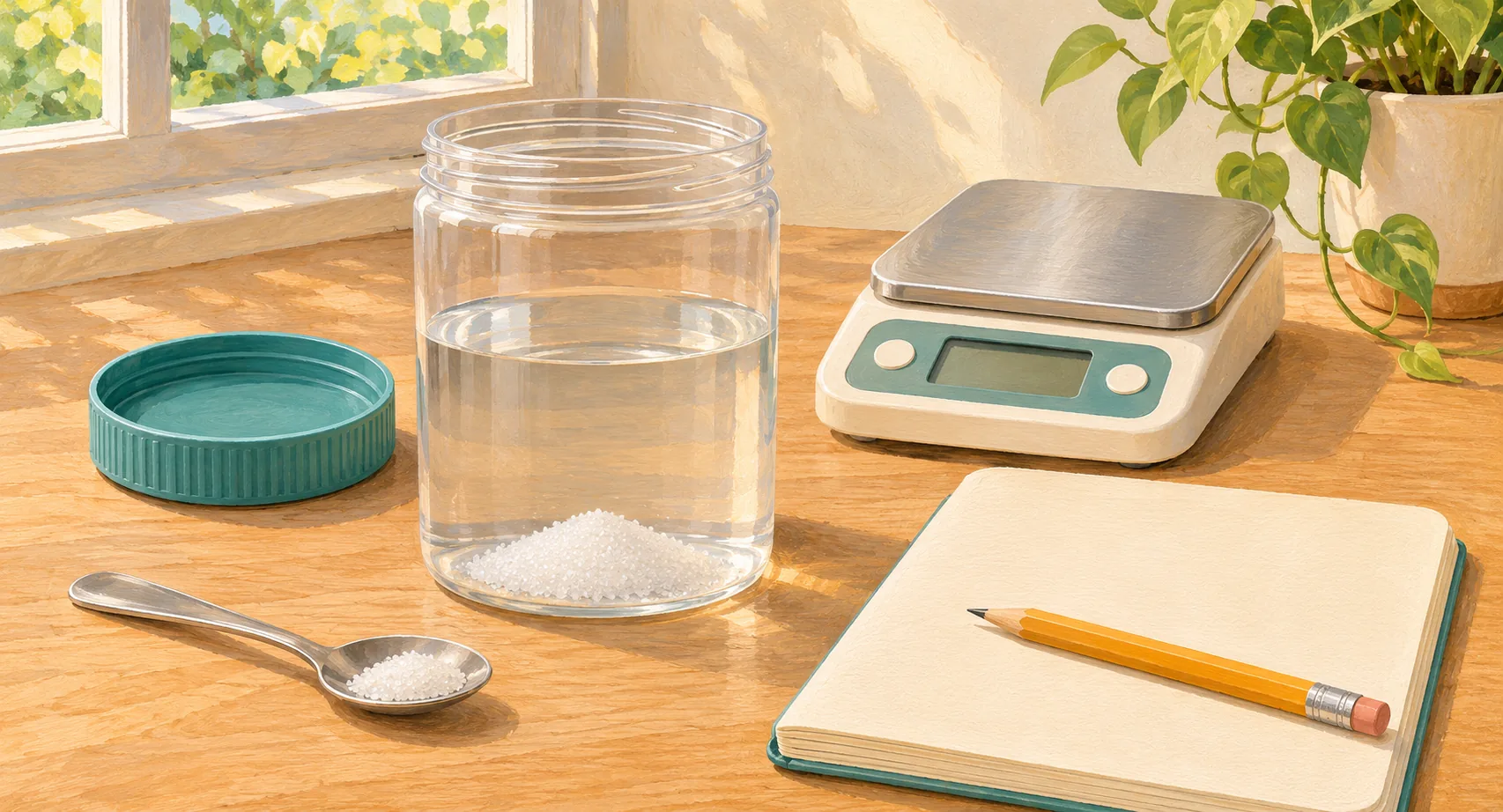
Stir a little sugar into a glass of water and ask your child where it went. “It disappeared” describes what they can see. Ask one more question. “Do you think it is still in the glass?” Their answer gives you something to investigate together during the school holidays.
Sugar dissolves in water. Its molecules separate from the crystals and mix among the water molecules. They are too small to see individually. The sugar remains part of the mixture, which we call a solution. A kitchen balance gives your child another way to check what has happened.
Predict the reading before mixing
For this home activity, gather a clear plastic jar with a secure screw lid, about half a cup of room-temperature water, a small dry cup, about half a teaspoon of sugar and a kitchen balance. Use a light tray if the items will not all fit safely on the weighing platform. The jar needs room for gentle swirling. An adult can help with pouring and closing the lid.
- Weigh the whole set. Put water in the jar and sugar in the small dry cup. Close the jar. Place the closed jar, the sugar cup and the teaspoon together on the balance, with the tray if you are using one. Record the mass in grams. Ask your child what they think the reading will be after the sugar dissolves.
- Move the sugar into the water. Take the items off the balance. Pour the sugar into the jar and close the lid securely. Keep the cup and teaspoon, including any sugar left on them, for the next weighing.
- Look closely. Gently swirl the closed jar. Check its base for crystals. If some remain, give it more time and swirl again. With this small amount of sugar in about half a cup of water, it should all dissolve. Keep the jar closed and the outside dry.
- Weigh the same set again. Return the closed jar, cup, teaspoon and tray to the balance. Include every item from the first reading. Let the display settle and compare the readings.
Explain what the balance can tell you
If nothing has entered or left the set, its total mass stays the same when the sugar dissolves. Ask your child to describe both observations. They can no longer see the sugar crystals, and the measured mass is unchanged within the balance’s precision.
Kitchen balances round their readings. If yours shows a small difference, check the setup before drawing a conclusion. Is the empty sugar cup back on the tray? Did any water spill? Is the balance on the same flat surface? Record what actually happened, including a spill or an uncertain reading.
The unchanged mass supports the idea that the sugar is still present. Its appearance has changed as it became mixed through the water. The molecules of sugar themselves remain sugar.
Try one question on paper
Here is a made-up example with just a jar, its lid and its contents. The closed jar of water has a mass of 208 g. You add 5 g of sugar without losing anything, then put the lid back on. What should the mass be immediately after adding the sugar? What about after all the crystals dissolve?
Check the two readings
Both readings should be 213 g. Adding the sugar gives 208 g + 5 g = 213 g. Dissolving it leaves the total at 213 g, provided all the water and sugar stay inside the closed jar.
Ask your child to explain why they chose the same or different readings before showing them the answer. You can use the same question another day with fresh numbers, then let them make up an example for you. The part to listen for is what stays in the jar.
The science explanation is supported by the Royal Society of Chemistry’s mass and dissolving resource. The American Chemical Society’s conservation of mass lesson also explains weighing dissolved sugar and allowing for measurement precision. The complete-set home activity and practice question here are the Genie team’s suggestions.