
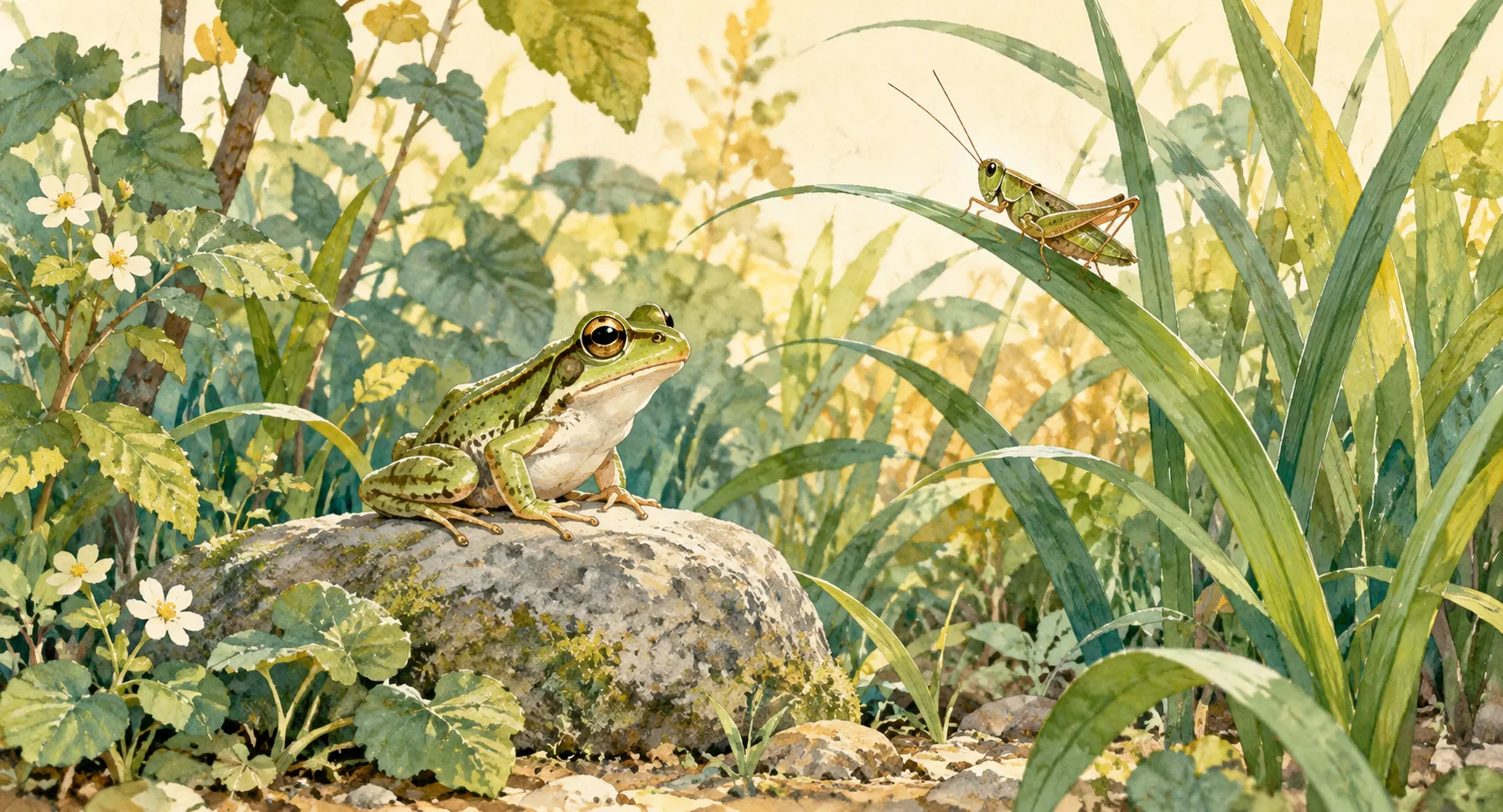
A food-chain question can look straightforward until your child has to explain an arrow. They may name every animal correctly, then write that the frog is eaten by the grasshopper. Before asking them to revise the whole topic, check how they are reading that one symbol.
Here is a short practice routine for Singapore families working through Science homework. It uses a familiar food chain, a reversed layout and two explanation questions. The routine and questions are our own teaching suggestions, not official examination instructions or a marking scheme.
Start with what the arrow means
In a food chain, an arrow shows the direction in which energy passes through feeding. It points from the organism being eaten towards the organism that eats it. NParks illustrates this with grass, a grasshopper, a frog and a snake in its guide to food chains and food webs.
Grass → grasshopper → frog → snake
Read one link: the grasshopper is eaten by the frog. Energy passes from the grasshopper to the frog when the frog eats it.
This is a simplified example, not a claim that these are the only feeding relationships in a Singapore garden. The grass is the producer in this chain: it uses light energy to make food. The animals are consumers. A food web joins multiple feeding relationships; an animal may have more than one food source.
Ask your child to point to just one arrow and finish this sentence: “Energy passes from ___ to ___.” Then ask them to explain who eats whom. Hearing both versions makes a reversed interpretation easier to spot.
Change the layout, then check again
A student who has memorised “read left to right” may get the first chain right without understanding the arrows. Write the same feeding relationships in the opposite layout:
Snake ← frog ← grasshopper ← grass
Ask: “What does the frog eat in this diagram?” The answer is still the grasshopper. The arrowhead points towards the frog, even though the frog is now to the left of the grasshopper.
If your child hesitates, avoid adding several new facts at once. Cover the snake and grass with two pieces of paper so that only the middle pair remains. Let them trace the arrow with a finger and explain it again. Remove the paper once that link is clear.
Build a reason, one feeding link at a time
Next, consider a question about a change in population. NOAA explains that changes in a food web can affect other organisms directly or through a sequence of effects in its food-web resource. For practice, keep the assumptions visible and follow only the relationships given.
Practice question: In the simple chain above, the number of frogs falls. Assume the other conditions remain unchanged. What might happen to the number of grasshoppers? Explain your answer using the feeding relationship.
Open the suggested explanation
The number of grasshoppers may increase because fewer frogs are available to eat them. Fewer grasshoppers may therefore be eaten.
This is a prediction within the simplified model. It does not tell us an exact population, a timescale, or what must happen in a real habitat.
A response such as “grasshoppers increase because frogs decrease” states two changes, but leaves the relationship unstated. Ask: “What do frogs do to grasshoppers in this chain?” Help your child add that missing reason in their own words.
For a second step, ask what might happen to the grass if the grasshopper population increases. More grasshoppers could eat more grass, so the amount of grass may decrease, assuming the other conditions remain unchanged. Real food webs include alternative food sources and other influences; the short chain cannot predict every outcome.
Try a question that checks the direction
Put the reversed chain back on the page and ask your child to work independently before opening the answer.
Practice question: A student reads “frog ← grasshopper” and writes, “Energy passes from the frog to the grasshopper.” Is the statement correct? Explain.
Open the direction check
No. The arrow points from the grasshopper towards the frog. The frog eats the grasshopper, so energy passes from the grasshopper to the frog through feeding.
If your child gets this right, ask them to draw the same relationship vertically and explain it once more. A correct answer in a new layout is a useful check of this particular idea; it does not establish that the whole topic is secure.
Keep the next homework step small
After the activity, make a brief note of what needed help: arrow direction, identifying a feeding relationship, or explaining a population change. These are different starting points for the next conversation with a teacher.
You do not need to turn a short homework check into a second lesson. Return to one comparable question another day and let your child try first. If they repeatedly reverse arrows, bring one example of their work and ask the teacher which part of the explanation to practise.
For another Science skill, see our guide to using numbers in data answers. If you are considering support with Science, you can explore Genie's Science programmes and discuss the difficulty your child is having.
Sources checked on 30 October 2026: NParks BiodiversitySG and NOAA, linked above. The practice routine and suggested answers are original Genie examples; they do not reproduce an examination question.