
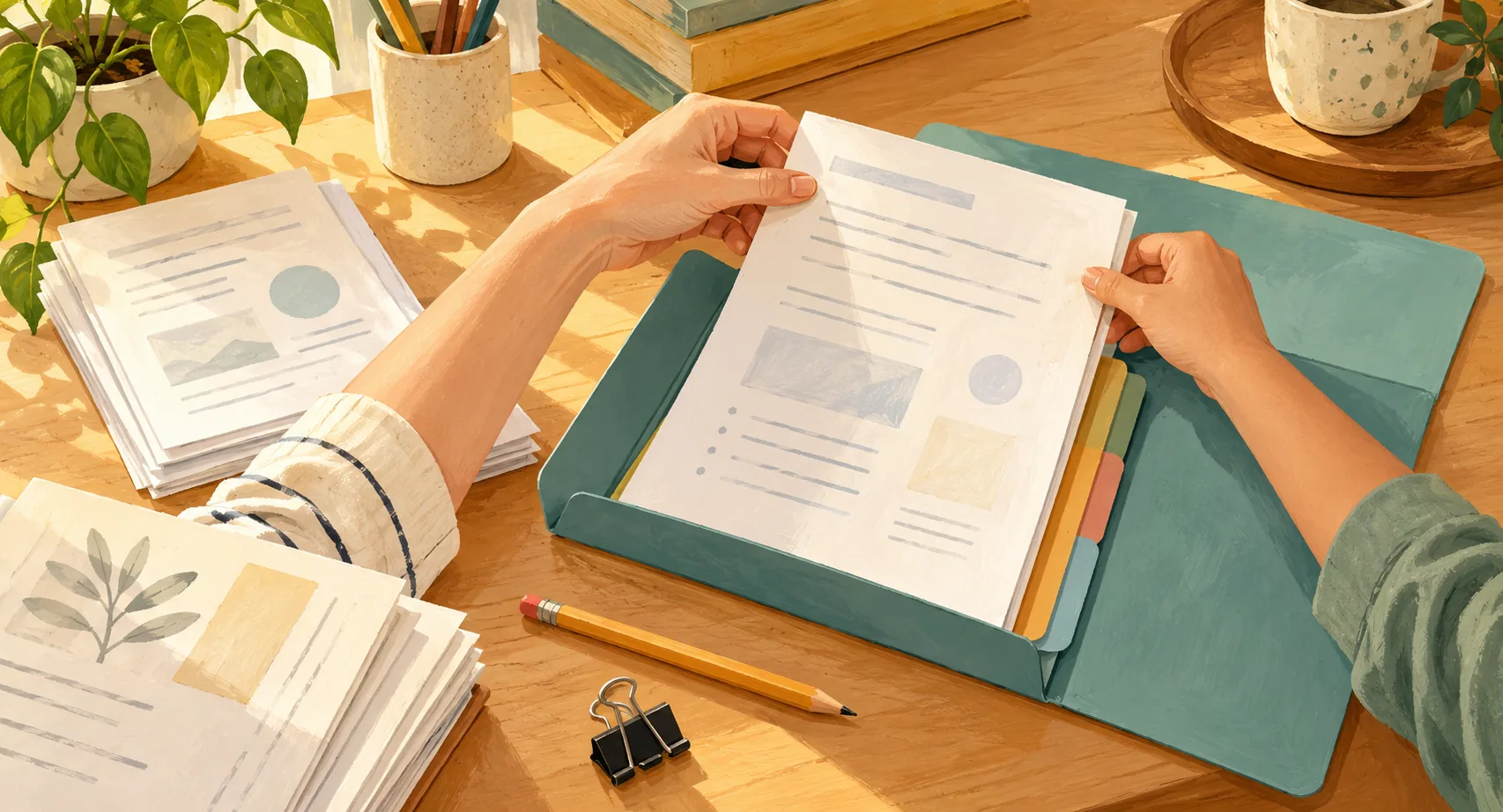
A worksheet slips out of a school bag. There is another pile beside the printer, and a file that no longer closes. You want to clear some space, but it is hard to tell what your child might need again.
Start with one subject and one small pile. The aim is to leave your child with papers they can find and use. Let the rest wait until your child has found a system they can use.
The routine below is our own practical suggestion for families. Follow your child's school instructions about materials that must be kept, completed or returned.
First, protect papers that still have a job
Before sorting for storage, put aside anything needed for current lessons, unfinished homework, corrections awaiting checking, or a task with a deadline. Check the school diary, assignment instructions or teacher's message if you are unsure. A paper handed back on Friday may still be due for corrections on Monday.
Keep official records, certificates, borrowed materials and documents requiring a parent's action out of the clearing pile. Handle those separately. If your child still has assessments ahead, avoid clearing the relevant revision materials simply because another subject's assessment is over.
Hand your child two of the remaining sheets and ask, “Which would you look for again? Show me what you would use it for.”
Give each paper a clear next step
Three temporary piles are enough. Use an existing folder or tray until you know how much space you need.
| Pile | What belongs here? | Next step |
|---|---|---|
| Keep | Required materials, useful explanations and selected examples your child wants to revisit. | File by subject and add a useful label. |
| Check | A paper with an unclear instruction, unresolved correction or uncertain future use. | Write down what needs checking and who can help. |
| Clear | Unneeded duplicates or rough work that contains nothing you still need. | Confirm together before discarding. |
“Check” should have a next action. Try a slip that says “Ask whether this booklet is needed next term.” If a decision depends on the teacher, keep the booklet until you have an answer. Slip the question inside the front cover so your child remembers what to ask.
Choose the pages your child will reach for
A high-scoring paper may contain a helpful method. A lower-scoring paper may contain a correction your child finally understood. Neither the score nor the thickness of the booklet tells you its future use.
Ask your child to choose a few pages and finish the sentence “I am keeping this because…” The reason could be a clear explanation, a question they still want to ask, or something they are proud of. You do not need a fixed quota.
Two possible labels
Math — subtracting fractions: “This shows why I changed one-half to two-quarters before subtracting it from three-quarters.” Keep the question, working and correction together, so the method still makes sense later.
Science — explaining an answer: “I can describe what happened, but I want to ask why my explanation was incomplete.” Flag the exact sentence and keep the question with the teacher's feedback.
A completed correction may still need discussion. Try covering the answer and asking what the first step means. If there is one persistent question, our guide to talking to the teacher with one clear example can help you prepare it.
Let your child help design the file
Choose labels your child understands. “Fractions — questions to revisit” may be easier to use than a complicated colour system that only a parent remembers. For a younger child, offer two workable choices, such as a subject folder or a small set of subject dividers. An older child can suggest their own arrangement.
For a child who hesitates, narrow the decision to two papers. For an older child, ask them to choose a label you could both find. The joint HPB, MOE and MSF Parenting for Wellness guidance on supporting independent decisions encourages age-appropriate choices. Our filing suggestion applies that broader idea at home.
Ask your child to find a page they chose. If neither of you knows where to look, change the label or reduce the number of sections.
Clear thoughtfully, and leave room for keepsakes
Before discarding, check both sides of a sheet and make sure you have not separated a question from its answer or feedback. Remove or securely dispose of personal details before putting paper into recycling. Do not post identifiable schoolwork online as part of a tidy-up.
Your child might want to keep their first independent solution, a favourite drawing or a project they enjoyed. Agree on a separate place for a few keepsakes. Ask before throwing away something they value.
You can photograph a selected page if that genuinely makes it easier to retrieve, but name the file clearly and check that the writing is readable. Keep an original whenever the school requires it. Scanning every sheet can simply move an unmanageable pile onto a device.
Finish with a file your child can use
Put current work somewhere accessible, stored reference papers in their agreed place, and unresolved questions where they will be noticed. Leave the next subject for another day if everyone has had enough.
When your child later needs a kept example, encourage them to explain the method or attempt the question again. Our read, cover, try guide offers one way to use a worked Math example.
Before you put the folder away, let your child pick one page worth coming back to. Ask them where they will put it and what they would like to do with it next time.