
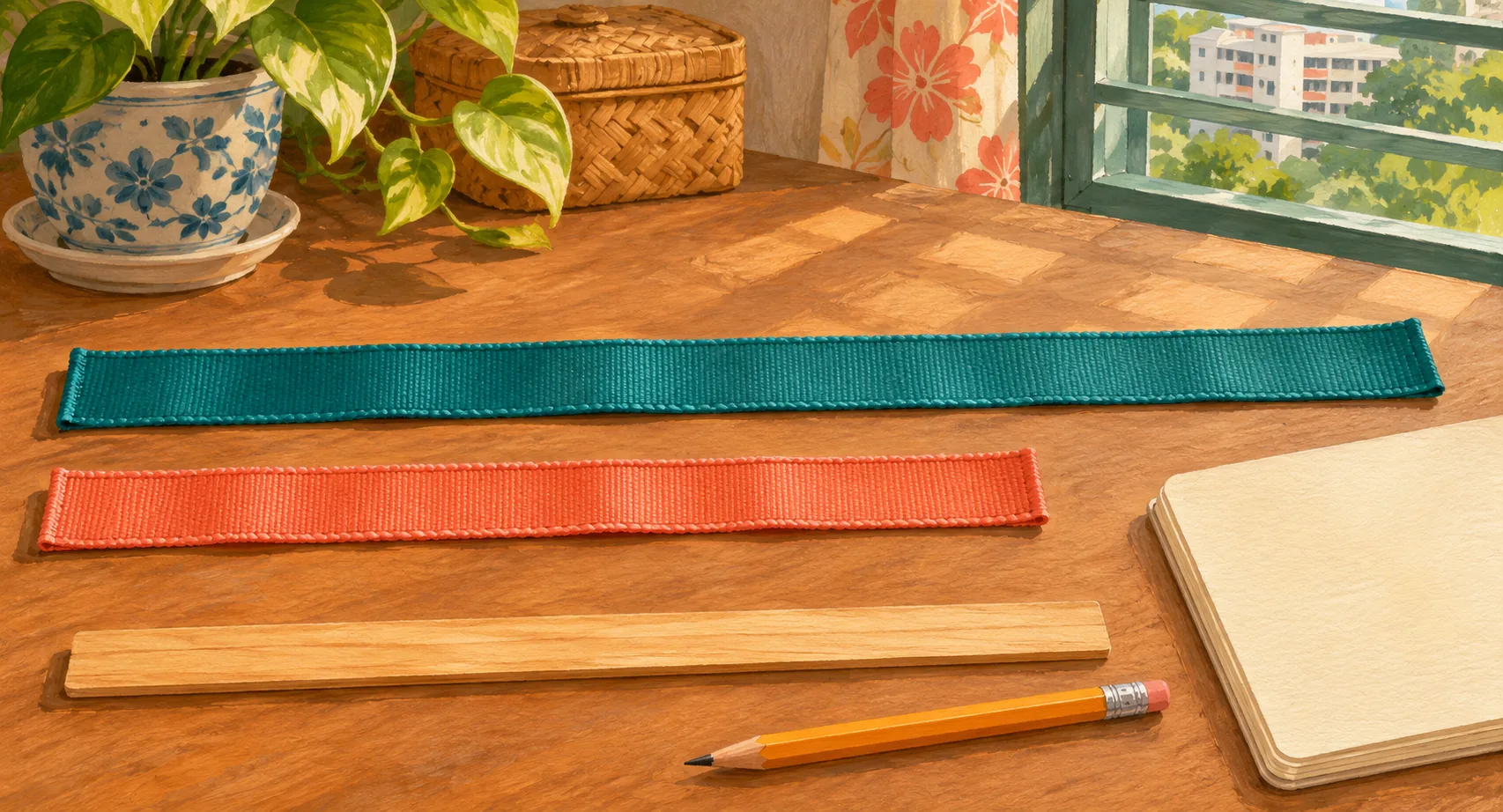
“Half is bigger than a third.” Your child is right when comparing the numbers ½ and ⅓. Now ask them to imagine two ribbons. One is 12 cm long and the other is 24 cm long. Would half of the shorter ribbon give you more ribbon than a third of the longer one?
Let them make a prediction before reaching for a calculation. Then ask, “Half of which ribbon?” In a question about a fraction of an amount, identifying the whole gives the fraction its meaning in that situation.
Draw the whole length first
You can try this with a pencil and squared paper during the school holidays. Draw a 12-square strip and label it 12 cm. Below it, draw a 24-square strip and label it 24 cm. Keep the squares the same size so the longer ribbon looks twice as long.
Ask your child to divide the shorter strip into two equal parts and shade one part. Each half is 6 squares long, representing 6 cm. Next, divide the longer strip into three equal parts and shade one. Each third is 8 squares long, representing 8 cm.
12 cm whole ribbon · ½ of it is 6 cm
24 cm whole ribbon · ⅓ of it is 8 cm
Read the conclusions together. Half of the 12 cm ribbon is 6 cm. A third of the 24 cm ribbon is 8 cm. The piece from the longer ribbon is 2 cm longer.
The numerical comparison still holds. ½ is greater than ⅓. Here, applying those fractions to different whole lengths gives pieces of 6 cm and 8 cm. Writing the words “of 12 cm” and “of 24 cm” keeps both parts of the question visible.
Keep the whole the same for a second try
Now draw two strips that are both 12 squares long. Shade half of the first and a third of the second. Ask your child what changed from the first pair of drawings.
This time, the shaded lengths are 6 cm and 4 cm. Half of a 12 cm ribbon is longer than a third of a 12 cm ribbon. Equal-sized wholes let the shaded pieces show the comparison between the fractions directly.
If your child draws both pieces as the same length, ask them to count the squares in each whole and each equal part. That gives you a specific step to talk through together.
Ask them to name the whole in words
Before your child works out a fraction of an amount, invite them to finish this sentence. “The whole is ___, and I am finding ___ of it.” For the longer ribbon, that becomes “The whole is 24 cm, and I am finding one third of it.” Dividing 24 by 3 now has a clear purpose.
For a fresh question, one ribbon is 18 cm long and another is 16 cm long. Compare ⅔ of the 18 cm ribbon with ¾ of the 16 cm ribbon. Let your child draw or calculate, then check the answer together.
Check the two ribbon pieces
Both pieces are 12 cm long. For the first, 18 ÷ 3 = 6, then 6 × 2 = 12. For the second, 16 ÷ 4 = 4, then 4 × 3 = 12. The fractions describe different shares of different whole lengths, and the resulting lengths are equal.
When you look back over their working, ask them to point to the number that represents each whole. Adding that label to a drawing is a small, practical step they can use again in their next Math question.
The same-sized-whole idea is discussed in Illustrative Mathematics’ resource on comparing fractions with a different whole. The ribbon examples, drawings and home-practice prompts here are the Genie team’s suggestions.