
Many parents notice the same frustrating pattern.
Their child spends time on homework, attends school regularly, and seems to understand what was taught in class. But when the test paper comes back, the marks still do not reflect the effort.
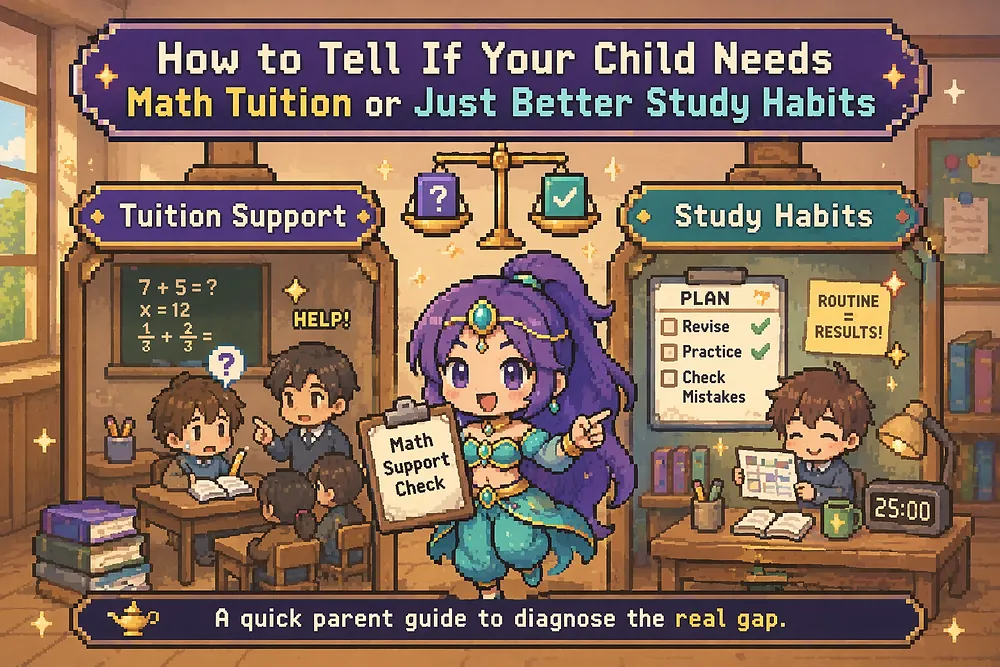
At that point, one question naturally comes up: Does my child actually need Math tuition, or do they simply need better study habits?
The answer is not always obvious. Some students truly need extra guidance to rebuild weak foundations. Others may already understand the concepts, but are being held back by inconsistent revision, poor exam habits, or careless mistakes.
Knowing the difference matters. When parents identify the real issue early, they can choose the right form of support instead of relying on guesswork.
Start by Looking at the Pattern, Not Just the Marks
A low score alone does not automatically mean a child needs tuition. Sometimes, the bigger clue lies in how the marks are lost.
For example, a child may:
- understand examples during class but forget methods quickly after
- make frequent careless mistakes in simple questions
- struggle to complete papers on time
- avoid showing full working
- panic when questions are phrased differently from what they have seen before
These issues may look similar on a report card, but they do not all come from the same root problem. Some point to weak study habits. Others point to gaps in understanding that tuition may help address.
Signs Your Child May Need Better Study Habits
In some cases, the child does not lack ability. They lack consistency, structure, or effective revision methods.
1. They Understand the Topic When It Is Explained, but Forget It Soon After
If your child can follow along during lessons and even answer correctly at first, but forgets the method a few days later, the problem may be retention rather than understanding.
This usually means they need:
- regular review
- spaced practice
- short revision sessions instead of last-minute cramming
2. They Only Study When a Test Is Near
Some students rely too much on urgency. They do not revise steadily, so each test feels like starting from scratch. Math improves best through repeated exposure. Without that, even capable students become rusty.
3. They Rush Through Work and Make Avoidable Mistakes
If your child often says, "I knew how to do it, I just made a careless mistake," that may point more to habits than understanding.
Common examples include:
- copying numbers wrongly
- skipping steps
- missing units
- reading the question too quickly
- keying the calculator wrongly
When this happens repeatedly, better checking routines and more disciplined presentation may help more than extra teaching alone.
4. They Are Inconsistent From Paper to Paper
If one paper is quite decent and the next drops sharply, that often suggests unstable habits. Students with real conceptual gaps tend to struggle more consistently. Students with poor habits tend to swing up and down depending on focus, fatigue, and whether they revised in time.
5. They Do Not Know How to Revise Math Properly
Many children think revising Math means rereading notes. But Math is a subject that improves mainly through active practice.
A child who is bright but revises passively may not need tuition immediately. They may first need guidance on how often to practise, how to review mistakes, how to organise weaker question types, and how to build exam stamina over time.
Signs Your Child May Need Math Tuition
On the other hand, some children are not just struggling with habits. They are missing core understanding that makes school lessons increasingly hard to follow.
1. They Do Not Understand the Basics Well
If your child is shaky in foundational topics, later chapters become much harder.
For upper primary students, this may show up in weak multiplication and division fluency, difficulty with fractions and ratios, weak model drawing, or trouble breaking down word problems.
For secondary students, it may look like discomfort with algebra, weak manipulation of equations, confusion with negative numbers and indices, or difficulty connecting concepts across topics. When the foundation is weak, better habits alone may not be enough.
2. They Often Do Not Know How to Start a Question
One strong warning sign is when the child looks at a question and freezes. This is different from making careless mistakes. It suggests they do not know what the question is testing, what method to use, what clues to look for, or how to structure the first step.
A student in this position often benefits from guided teaching and repeated exposure to question types.
3. They Cannot Explain Their Thinking Clearly
A child may sometimes get answers by instinct, guesswork, or half-remembered methods. But when asked to explain, they cannot say why they did a step. That usually means understanding is not secure.
Good tuition can help make thinking clearer and more systematic, rather than leaving the child to rely on trial and error. Read more in Why Knowing the Answer Isn't the Same as Understanding the Concept.
4. School Lessons Are Moving Too Fast for Them
Some children fall behind not because they are lazy, but because the pace of school does not give them enough time to absorb the material. Once this happens for a few topics in a row, confidence often drops too.
Tuition may help by giving them extra guided practice, slower explanation, targeted revision, and a chance to ask questions they were too shy to ask in school.
5. Their Confidence in Math Is Falling
When children keep struggling, they often stop trying properly. They may say things like "I'm just bad at Math," "I don't get anything," or "There's no point trying."
At this stage, tuition can help not just academically, but emotionally. A child who experiences small wins again often becomes much more willing to engage.
Sometimes the Answer Is Both
In reality, many children need both better study habits and academic support. For example, a student may have weak fractions, poor revision habits, and low confidence all at once.
In such cases, tuition alone will not fully solve the problem if the child still does no follow-up work at home. But habits alone also will not solve it if the foundation is already weak. The goal is to identify which issue is the main bottleneck.
A Simple Way Parents Can Assess the Situation
Before deciding, ask these questions:
- Does my child understand the method after it is explained?
- Can they do similar questions independently later on?
- Are they losing marks mainly from carelessness, or from not knowing what to do?
- Do they revise consistently each week?
- Do they avoid Math because they dislike effort, or because they genuinely feel lost?
Your answers will often point you in the right direction. If your child generally understands but is inconsistent, habits may be the first thing to fix. If your child is confused, lost, and increasingly unable to cope with school topics, tuition is likely worth considering.
What to Do Next
If you think the issue is mainly study habits, start with a few simple changes:
- set a fixed weekly Math revision routine
- get your child to redo corrections properly
- focus on a few weak question types each week
- teach them to show full working and check systematically
If you think the issue is deeper than habits, look for tuition that does more than just hand out extra worksheets. A good Math tuition programme should help your child understand concepts clearly, identify question types, develop proper working and presentation, strengthen weak foundations step by step, and gain confidence through guided practice.
Final Thoughts
Not every child with weak Math results needs tuition immediately. Sometimes, the real problem is poor revision habits, weak discipline, or ineffective practice.
But when a child is consistently confused, unable to start questions, or missing key foundations, extra support can make a big difference.
The most helpful question is not, "Should I send my child for tuition because the marks are low?" It is, "What is actually causing my child to struggle?" Once parents identify that clearly, the next step becomes much easier.